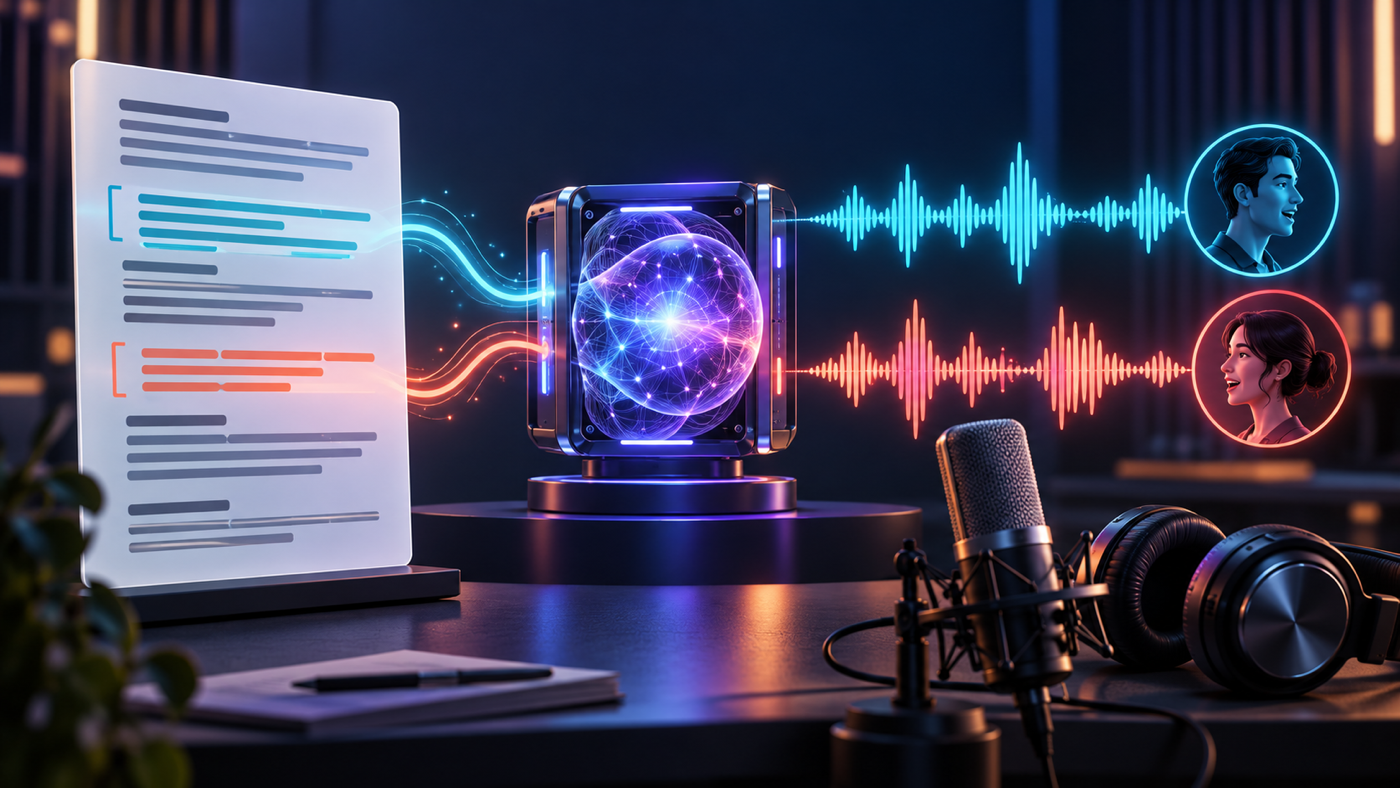
Fish Audio’s October 13 release of Drama 3 puts vocal performance at the center of text-to-speech. Creators can describe emotion and pacing, place laughs or breaths, and change delivery partway through a sentence.
It is available on the web, iOS, Android, and through the API. Fish Audio says it supports 83 languages.
Directing a performance from the script
For developers, the practical features are:
- Plain-language performance directions embedded in the script.
- Multi-speaker dialogue in a single request.
- The existing speech endpoint, with
drama-3selected through the model header.
Directions go in square brackets before the words they apply to. In a multi-speaker request, speaker tags select among the supplied voice IDs, while directions can shape each turn’s delivery.
Launch pricing and editing availability
API pricing is $10 per million characters from October 13 through November 12, 2026, versus a $50 list price. This is a time-limited launch offer, not the permanent API rate.
Interactive editing and word-level audio inpainting remain in small, invite-only testing—not generally available editing features. For now, users can change a line’s direction and generate another take.
Why it matters
For app builders and small studios, this could make narrated tutorials, game dialogue, and localized product videos easier to shape without recording every variation.
SunMarc’s app walkthroughs offer a concrete evaluation use case. Steps from the QR Remix user guide, for example, could become a narrated product demonstration. Compare pronunciation, consistency, and cost across repeated takes before adopting it for production.
Open weights with commercial conditions
Self-hosting is possible, but open weights do not mean unrestricted use. The Fish Audio Community License v1.0 permits eligible commercial use while the licensee and its affiliates have less than $500,000 in combined annual revenue, subject to its other conditions.
Hosted speech-generation services require a separate agreement regardless of revenue. Teams considering self-hosting should read the actual license for the precise scope, exceptions, and requirements; generating finished audio is not the same as offering others a speech-generation service.