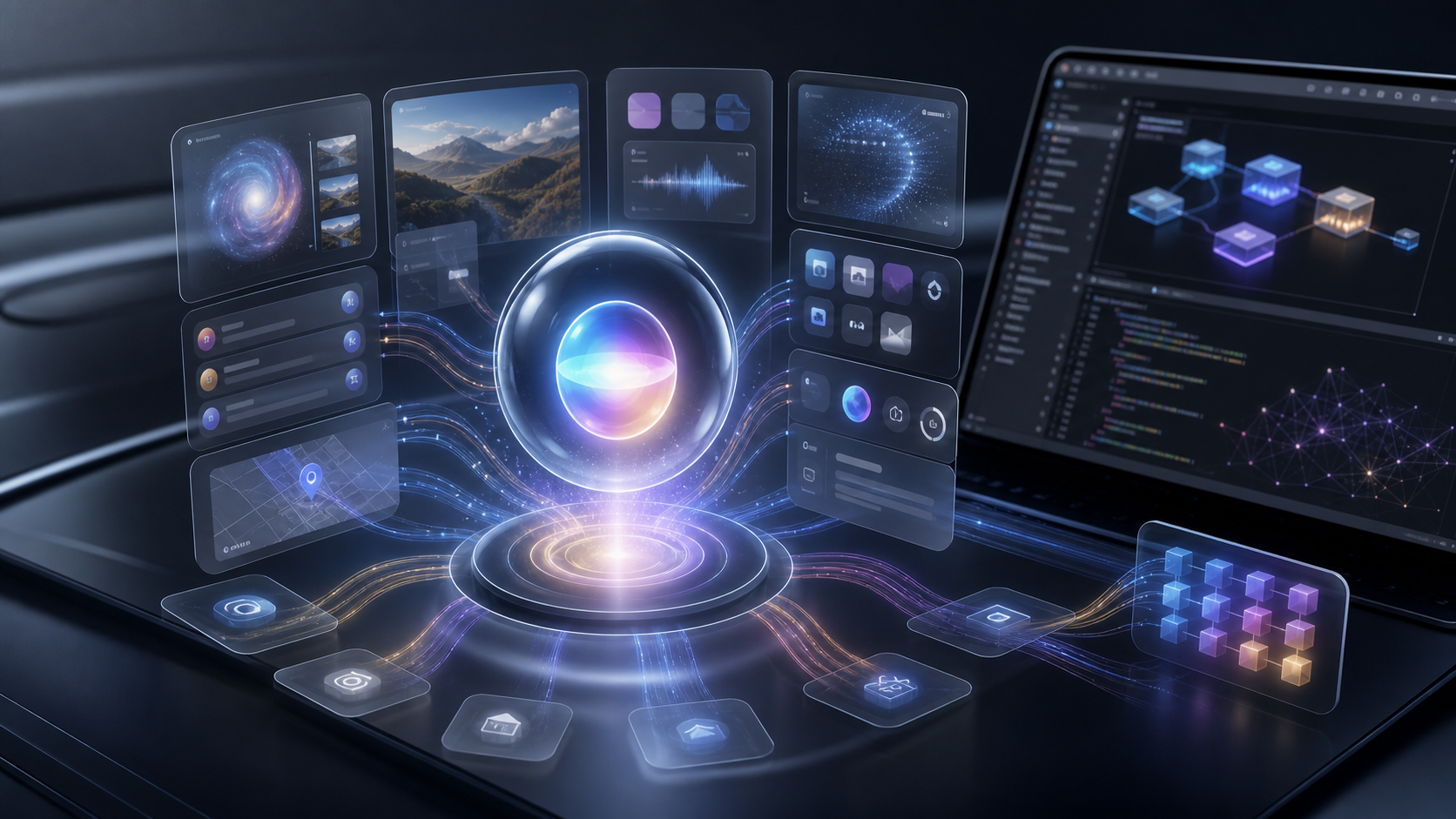
Apple used WWDC26 to introduce Siri AI, a ground-up rebuild of its assistant powered by the next generation of Apple Intelligence. The new Siri is designed to hold an actual conversation, understand what is on a user's screen, search personal information across apps, reach the web for current knowledge, and take actions throughout the operating system.
That combination matters more than any single demo. Apple is trying to turn AI from a collection of optional features into a system layer that sits between users, their information, and the apps on their devices. At the same time, it is giving developers more ways to participate in that layer rather than reserving the most useful capabilities for Apple's own software.
Siri becomes a system interface
Siri AI can draw on messages, email, photos, files, and other personal context to find information that would otherwise require opening several apps and searching manually. Onscreen awareness lets it answer questions about the content currently in view. Broad world knowledge adds current information from the web, while follow-up conversation allows users to refine a request instead of starting over with every command.
The action layer is the more consequential part. Apple says Siri can perform systemwide tasks such as drafting an email, editing and sharing photos, or moving information from one context into another. On iPad and Mac, Siri is integrated into Spotlight. It also appears in system context menus, making images, files, and selected text potential starting points for an AI-assisted action.
This is a different product position from a chatbot that lives in one app. The assistant is being placed where users already work, with access to the operating system's indexes, interfaces, and action surfaces. If it works reliably, the distinction between asking a question and operating software starts to narrow.
The architecture is built around private context
Apple says the rebuilt Siri uses foundation models running both on device and on servers protected by Private Cloud Compute. A system orchestrator can also use on-device capabilities such as the Spotlight index and App Toolbox. The architecture reflects the central tension in personal AI: the most useful assistant needs deep context, but that context includes some of the most sensitive information on a device.
Apple's answer is to keep as much execution as possible on the user's hardware and send larger requests to a cloud system designed so personal data is not stored or exposed to Apple. The practical test will be whether that privacy design can coexist with fast, dependable actions across a growing number of apps.
Apple opens more of the model layer
The developer story extends beyond Siri. Apple expanded the Foundation Models framework introduced last year, adding multimodal prompts so apps can pass images alongside text. Developers can use Apple Foundation Models, connect supported cloud models, or provide another model through the framework's language-model protocol. Apple is also opening access to its next-generation models on Private Cloud Compute for qualifying small developers.
Core AI provides a separate route for developers who want to bring their own models to Apple silicon. It offers an on-device Swift framework, model conversion tools, hardware specialization, profiling, and deployment support across iPhone, iPad, Mac, and Apple Vision Pro. In other words, Apple is not forcing every AI feature through one model family or one cloud service.
Together, Foundation Models and Core AI give app makers several architectural choices: use Apple's on-device model, reach a larger Apple model through Private Cloud Compute, connect another provider, or package a specialized model that runs locally. That flexibility is important because the best model for a writing assistant may not be the best model for image analysis, classification, navigation, or a narrow utility workflow.
App Intents becomes a distribution surface
App Intents is the bridge between Siri and third-party software. Developers can describe the actions and content their apps make available to the system, allowing Siri, Spotlight, Shortcuts, and other Apple experiences to discover and use them. Personal context can also extend into third-party apps when developers integrate with Spotlight.
For product teams, this changes the meaning of app discoverability. A user may increasingly reach a feature without navigating to the app's home screen first. They might ask Siri to retrieve a record, create an item, transform content, or continue a workflow, with the app acting as a capability provider behind the system interface.
That opportunity comes with a demanding product requirement: an app's useful actions need to be modeled clearly. Features that depend on a long sequence of hidden interface state will be harder to expose than focused actions with understandable inputs, outputs, permissions, and confirmation steps.
Xcode 27 puts agents inside the development loop
Apple is also making AI agents part of the toolchain used to build these experiences. Xcode 27 agents can work across a project, operate the simulator, run tests, inspect results, and fix issues. Developers can use built-in model options or connect external agents through the Agent Client Protocol, while MCP tools can provide access to additional services and context.
This pushes coding assistance beyond autocomplete. An agent that can change code, build the project, interact with the app, observe a failure, and revise its work is participating in a feedback loop. The developer still owns architecture, product judgment, security, and release quality, but more of the mechanical path between an idea and a verified implementation can be delegated.
The direction resembles the broader shift toward agent platforms seen in Microsoft's Windows AI strategy. The major platform companies are not treating agents as standalone chat products. They are wiring them into operating systems, development environments, and the permissions needed to perform real work.
What product builders should take from WWDC26
The first lesson is that app functionality needs to survive outside the app's main interface. Teams building for Apple platforms should identify the small number of actions users genuinely want to invoke from Siri, Spotlight, Shortcuts, or another app. Those actions should be explicit, testable, permission-aware, and useful without forcing the user through unnecessary screens.
The second lesson is that model choice is becoming an implementation detail rather than a permanent product identity. Apple's frameworks support on-device models, private cloud execution, and external providers. Products should be designed around the job to be done, the sensitivity of the data, latency, cost, and reliability rather than around loyalty to one model vendor.
The third lesson is that system-level distribution creates system-level competition. If Siri can find information, draft content, or complete a routine action across apps, generic AI wrappers become less defensible. Apps need proprietary utility: trusted data, a specialized workflow, strong domain design, or a capability the operating system does not provide on its own.
What builders should take from this
The most relevant signal is the rise of capability-first app design. Utilities such as timers, navigation tools, QR workflows, and calculators become more valuable when their core actions can be called from the place where the user's intent appears. A timer should be easy to configure from a spoken request. A navigation tool should expose a precise destination or bearing action. A scanning utility should return structured information that another workflow can use.
Even teams centered outside Apple's ecosystem should treat this as a product-design benchmark. Google, Microsoft, and Apple are all moving toward assistants that coordinate actions across software. Designing features as clear, portable capabilities now makes future platform integrations easier and improves the apps themselves even before an assistant invokes them.
It also reinforces the importance of visible permissions and confirmation. An assistant that can act across apps needs to make the boundary between suggestion and execution obvious. For utility products, earning trust will depend less on how conversational the interface sounds and more on whether users can understand, verify, and reverse what it does.
Availability still limits the immediate impact
Siri AI entered developer testing on June 8 across iOS 27, iPadOS 27, macOS 27, and visionOS 27. Apple says the consumer beta will arrive later in 2026 for supported devices set to English, with more languages to follow. Apple Intelligence already supports Turkish, but that does not mean the initial Siri AI beta will launch in Turkish.
Hardware and regional restrictions also apply. Some advanced on-device features require newer devices, Siri AI will not initially be available on iPhone and iPad in the European Union, and Apple says the new AI features will remain unavailable in China while it works through regulatory requirements. The announcement is strategically significant now, but its real reach will expand in stages.
Apple's previous Siri approach was already showing the strain of placing an external model behind a system assistant, as we covered in the growing friction around the Siri and ChatGPT integration. WWDC26 is Apple's attempt to replace that patchwork with an architecture it controls from model execution through app actions. The next test is no longer whether Apple has an AI story. It is whether developers can turn the new stack into dependable experiences users choose to trust.
Relevant links
- Apple: Siri AI, a profoundly more capable and personal assistant
- Apple: Next generation of Apple Intelligence, Siri AI, and more
- Apple Developer: Five takeaways from the Platforms State of the Union
- Apple Developer: What's new in Apple Intelligence
- Apple Developer: Core AI
- Apple Intelligence and Siri overview