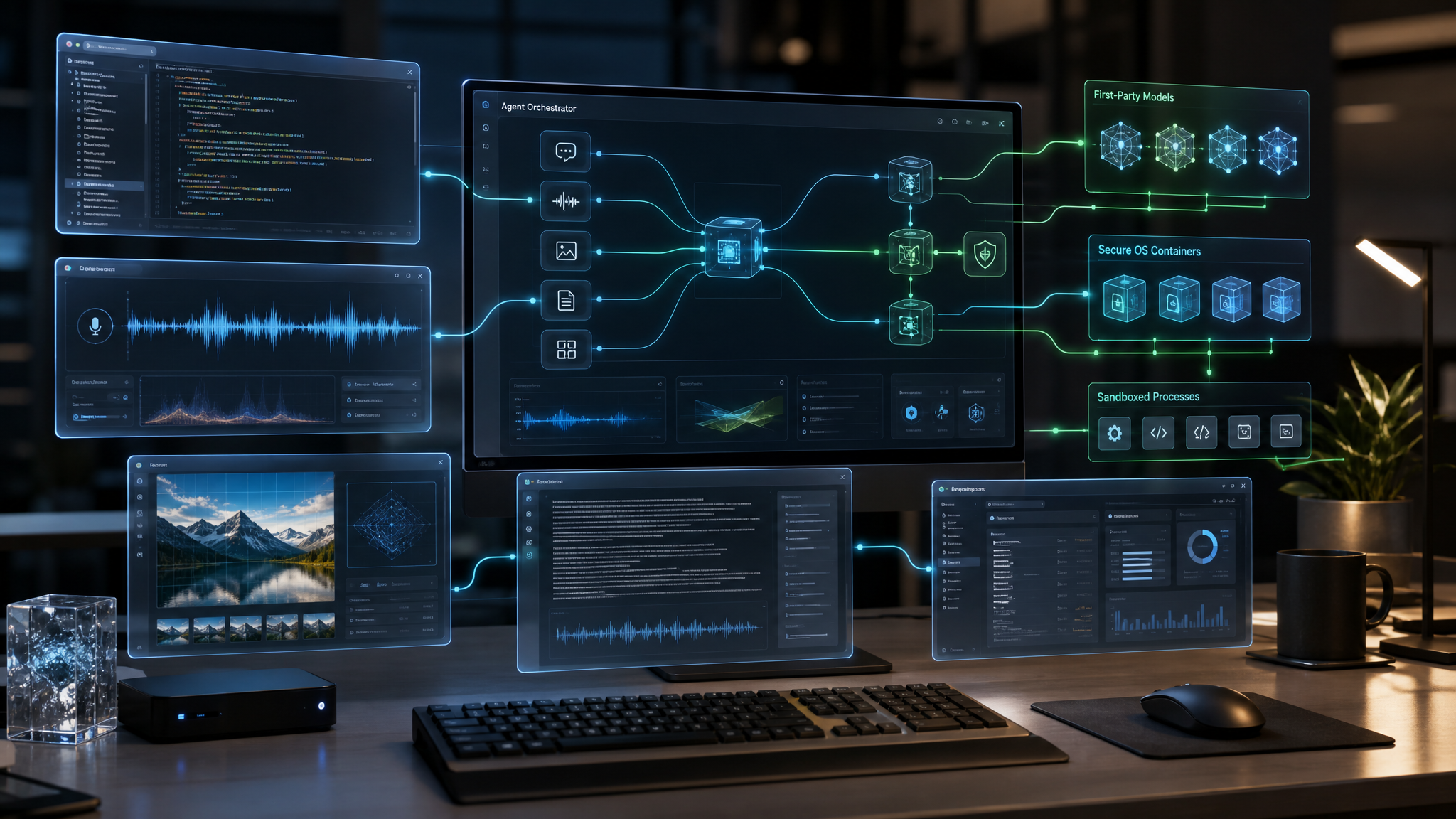
Microsoft used Build 2026 to make a clear statement: it does not want to be seen only as an OpenAI distribution layer anymore. Microsoft AI announced seven in-house MAI models across reasoning, coding, image generation, transcription, and voice, including MAI-Thinking-1, MAI-Code-1-Flash, MAI-Image-2.5, MAI-Transcribe-1.5, and MAI-Voice-2.
The more interesting signal is not just the model list. Microsoft is tying the models directly into the places where developers and businesses already work: GitHub Copilot, VS Code, Microsoft Foundry, Microsoft 365, Windows, and enterprise data layers.
That turns the announcement from a model launch into a platform move. Microsoft is building first-party models, but it is also building the runtime, context layer, sandbox, tuning system, and distribution surfaces those models need to become useful inside real workflows.
Microsoft is reducing model dependence
For years, the market has treated Microsoft as the strongest commercial route into OpenAI's models. That relationship still matters. But the MAI announcement shows Microsoft pushing toward more control over its own model roadmap.
Microsoft describes the new MAI family as a multimodal system built across reasoning, coding, image generation, transcription, and voice. The company says MAI-Code-1-Flash is designed for agentic coding and deeply integrated into GitHub Copilot, VS Code, and the Microsoft stack. MAI-Thinking-1 is positioned as a mid-weight reasoning model. MAI-Image-2.5, MAI-Transcribe-1.5, and MAI-Voice-2 fill out the creative and communication layers.
This is not only about having backup models. It gives Microsoft more pricing leverage, more product-specific tuning options, and a clearer path to ship AI features that are optimized for its own surfaces instead of waiting for a third-party model provider to fit every product need.
The OS layer is becoming part of the AI stack
The Build post is where the bigger platform story appears. Microsoft says Windows is becoming an agent-native runtime. That is not normal marketing language for an operating system. It means Microsoft expects agents to need local execution, local files, local tools, and local safety boundaries.
Microsoft Execution Containers, now in preview, are meant to provide OS-enforced sandboxed environments for agents. In practical terms, that is the kind of primitive agent software needs if it is going to run multi-step tasks near a user's files, code, browser state, credentials, or business applications.
Microsoft also says the technology is now being used by OpenClaw on Windows, enabling multi-step workflows inside OS-enforced boundaries. That detail matters because OpenClaw sits directly in the category Microsoft is describing: always-on operators that use memory, tools, sessions, files, and execution environments to complete work over time.
The pattern is clear. Agent infrastructure is moving below the chat interface. It is becoming part of the machine: containers, permissions, memory, local runtime, developer tools, and hosted sandboxes.
Agents need more than intelligence
Most AI product coverage still treats model quality as the whole story. Build 2026 points in a different direction. The next serious AI apps need models, but they also need context, tool access, evaluation, containment, policy controls, memory, and a way to hand work across local and cloud environments.
Microsoft's stack is being arranged around that idea. Microsoft IQ is pitched as a context layer for agents. Foundry provides hosted agent infrastructure. GitHub Copilot and VS Code provide developer entry points. Windows provides local runtime and sandboxing. MAI models provide Microsoft-owned intelligence tuned for those surfaces.
For builders, this is the useful part. The frontier is no longer "add a chat box to the app." The frontier is owning a workflow. A useful agent has to understand the task, access the right tools, respect boundaries, recover from failure, produce inspectable work, and operate inside the systems where people already spend their day.
What readers should take from this
The lesson is product strategy, not vendor trivia. AI products are becoming operating environments. The winning experiences will feel less like novelty assistants and more like reliable work surfaces: focused, permissioned, observable, and connected to real user intent.
That applies whether the product is a consumer utility, a navigation tool, a PDF workflow, a QR automation system, or a future AI-native app. If an app asks for user trust, it should make the boundaries visible. What can the system access? What can it change? What remains local? What is logged? When does a suggestion become an action?
Microsoft's announcement is a validation signal for that direction. The market is moving toward agents that live inside toolchains and operating systems. The useful opportunity is to build smaller, clearer products that borrow the same discipline: strong workflows, sharp permissions, practical automation, and human-readable control.
In plain terms: the next AI apps will not be judged only by the model behind them. They will be judged by whether they can safely own a slice of real work.
Relevant links
- Microsoft AI: Building a hill-climbing machine: Launching seven new MAI models
- Microsoft Build 2026: Be yourself at work
- Axios: Microsoft debuts Scout agent, homegrown reasoning model
- Windows Central: Microsoft launches seven in-house AI models
- SunMarc: NVIDIA And Microsoft Want The AI Agent To Move Onto The PC