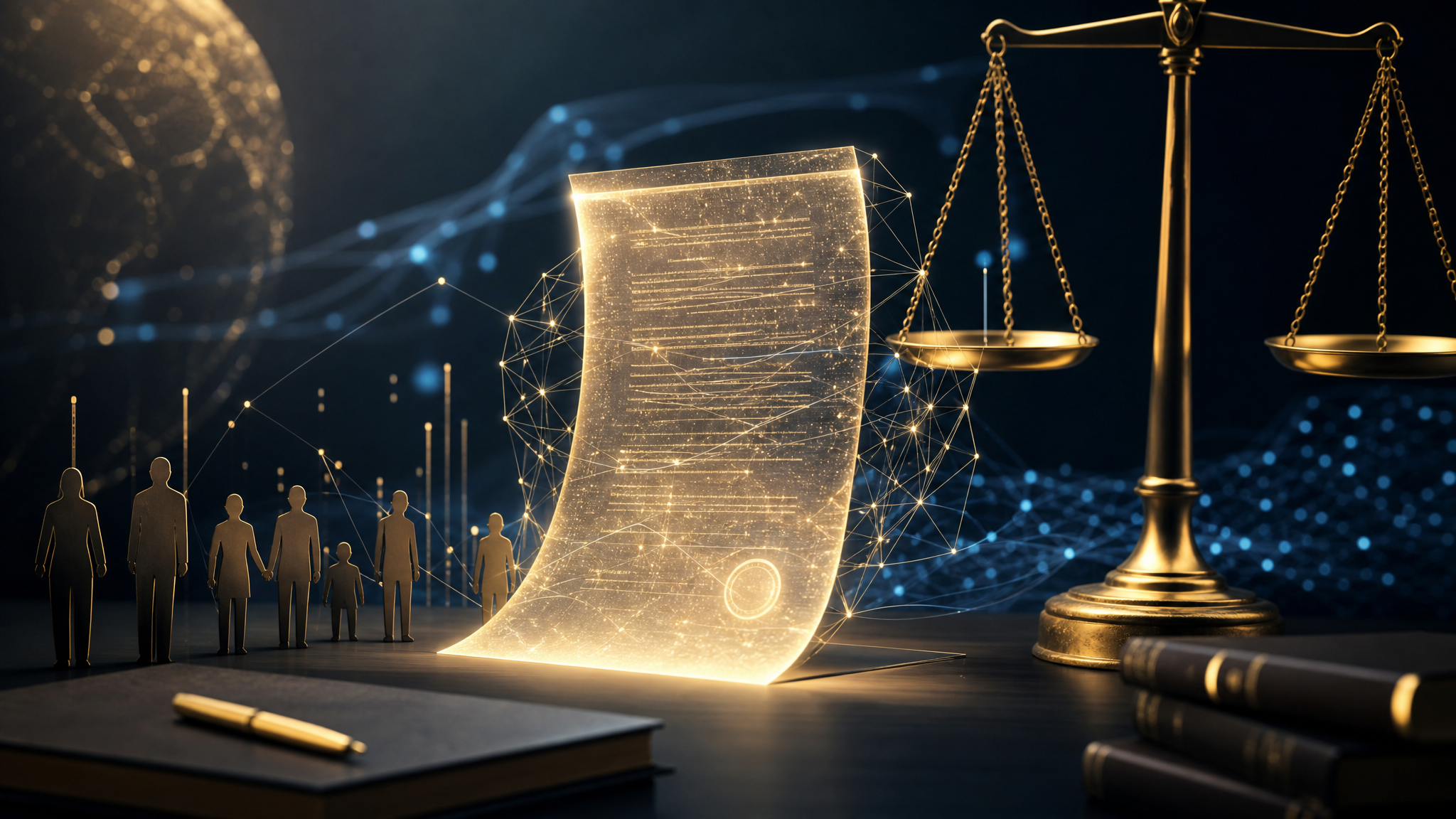
Pope Leo XIV released his first encyclical, Magnifica humanitas: On Safeguarding the Human Person in the Time of Artificial Intelligence, and it is unusually direct about where AI is heading.
The message is not anti-technology. It is a warning about power. The encyclical argues that AI should serve human dignity, truth, work, social justice, and peace — not become another system where data, infrastructure, platforms, and decision-making power concentrate in the hands of a few.
That makes this more than a religious document. It is part of a broader shift in the AI conversation: away from “what can the models do?” and toward “who controls them, who benefits, and who is made weaker by them?”
Why it matters
AI is moving into education, work, communication, warfare, and public opinion at the same time. Pope Leo's framing lands because it treats AI as infrastructure, not just software.
That distinction matters. Software can be evaluated feature by feature. Infrastructure reshapes the conditions around people: what information they see, what jobs become easier or harder, which decisions are automated, and how much control remains with the person affected by the system.
For builders, product teams, and small studios, the practical takeaway is clear: useful AI products will need more than clever automation. They will need visible responsibility — human oversight, transparent limits, fair access, and designs that do not quietly turn people into inputs for someone else's system.
The governance debate is getting less abstract
For much of the public, AI governance can sound like a distant policy topic. The Vatican's intervention helps make the stakes more concrete. It connects technical deployment to ordinary human concerns: whether people can trust what they read, whether workers are treated as replaceable, whether communities lose agency, and whether decisions that affect lives remain accountable.
This is where the AI industry is likely to face more scrutiny. A product can be impressive and still create dependency. A model can be capable and still be deployed in a way that hides risk. A platform can promise efficiency while concentrating knowledge, data, and leverage inside a smaller number of institutions.
The moral question is not whether AI should exist. The stronger question is what kind of AI ecosystem people are being asked to live inside.
Human dignity is a product requirement
For AI builders, “human dignity” can sound too broad to implement. It becomes practical when translated into product decisions.
Does the user understand when AI is involved? Can they challenge or override an output? Are limitations visible? Is personal data being protected? Does the product make a worker more capable, or does it mainly extract more output from them? Does it help a small team compete, or does it deepen dependence on a closed platform?
These are design questions as much as ethical questions. They show up in onboarding copy, permission screens, data-retention defaults, audit trails, export options, explainability, escalation paths, and whether the product is honest about what it cannot know.
The power layer matters
The encyclical's warning about concentration of power is especially relevant because the AI stack is expensive. Frontier models require compute, data pipelines, specialized chips, cloud contracts, talent, distribution, and legal capacity. That makes the industry structurally prone to centralization.
At the same time, smaller teams are building with AI APIs, open models, agent frameworks, and workflow tools. The opportunity is real, but so is the dependency risk. If the most important parts of a product depend on opaque models, changing terms, closed ranking systems, or platform-controlled distribution, builders can lose strategic freedom quickly.
Responsible AI, then, is not only about avoiding harmful outputs. It is also about preserving agency across the ecosystem: for users, workers, educators, creators, developers, and small businesses.
The practical takeaway
This reinforces a product principle readers should expect from AI tools: technology should make people more capable without making the relationship confusing or extractive.
That applies to utility apps, calculators, navigation tools, QR workflows, content systems, and future AI-assisted products. The strongest products will be specific, useful, transparent, and bounded. They will make the job easier while keeping the user clearly in control.
The AI market is still moving fast, but the conversation is maturing. The next durable layer will not be defined only by model performance. It will be defined by trust, accountability, workflow fit, and whether people feel stronger after using the technology — not smaller.
Relevant links
- Vatican News: Pope Leo XIV's encyclical on AI
- Vatican: Magnifica humanitas full text
- Vatican editorial analysis on AI and human dignity
- SunMarc archive: AI is moving from classroom hype to measured teaching tools
- SunMarc archive: Musk vs. OpenAI is now a governance test for the AI industry
- SunMarc archive: Gemini for Science shows where AI agents are headed next