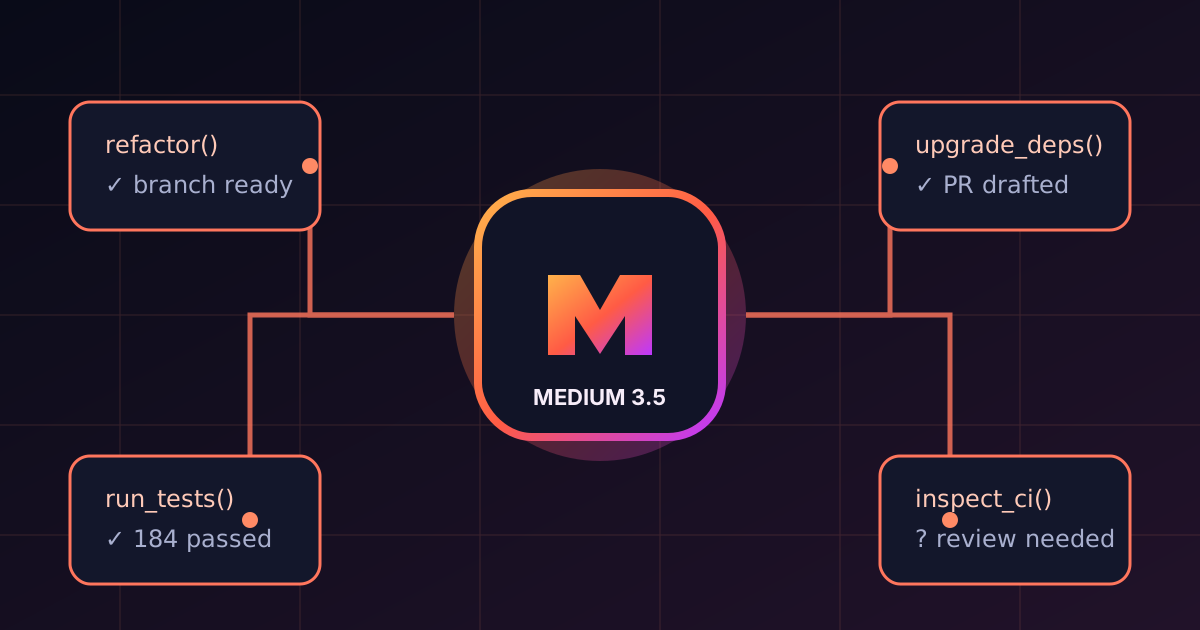
Mistral has introduced Mistral Medium 3.5, a 128-billion-parameter open-weight model that unifies instruction-following, reasoning, coding, and vision in one set of weights. The company is pairing it with Vibe Remote Agents, moving long-running coding work from a developer's laptop into isolated cloud sessions that can operate in parallel.
The combination matters more than either release in isolation. Medium 3.5 supplies the model capability, while Vibe packages that capability into a workflow where agents can edit code, run tools, surface questions, and return a branch or draft pull request for review.
One model for reasoning, coding, and tools
Mistral Medium 3.5 is a dense multimodal model with a 256,000-token context window. Reasoning effort can be configured per request, allowing the same model to handle a quick response or spend more compute on a complex agentic run. Native function calling and structured output make it suitable for systems where model responses must drive downstream software.
Mistral reports a score of 77.6% on SWE-Bench Verified and 91.4% on τ³-Telecom. These are vendor-reported benchmark results, but they help explain why Medium 3.5 now replaces Devstral 2 as the default model in Vibe and also powers Le Chat.
The model is available as open weights under a Modified MIT license, with exceptions for companies above the license's revenue threshold. Mistral says it can be self-hosted on as few as four GPUs. That gives teams a route to agentic coding performance without requiring every codebase or internal document to be sent to a third-party API.
Vibe turns coding sessions into cloud jobs
Vibe Remote Agents can be launched from the Vibe CLI or directly from Le Chat. Several tasks can run simultaneously, continue while the developer steps away, and notify the user when they finish. A local CLI session can also be “teleported” into the cloud with its history, task state, and approvals preserved.
During a run, developers can inspect file diffs, tool calls, progress, and questions. Each coding session operates in an isolated sandbox, and completed work can be returned as a GitHub pull request. Integrations with GitHub, Linear, Jira, Sentry, Slack, and Teams connect the agent to the issue, incident, and reporting systems around the codebase.
This workflow is particularly well suited to bounded, reviewable tasks: module refactors, test generation, dependency upgrades, CI investigations, and bug fixes. The developer's role shifts from supervising every action to defining the task, resolving important questions, and reviewing the result.
Work mode expands the same pattern beyond code
Mistral is also previewing Work mode in Le Chat. It uses a new agent harness powered by Medium 3.5 to complete multi-step research, analysis, inbox triage, and cross-tool workflows. The agent can work across web sources and connected business tools, calling several tools in parallel and persisting longer than a normal chat response.
Mistral says every tool call and its rationale remain visible. Sensitive actions—such as sending a message, writing a document, or modifying data—require explicit approval based on the user's permissions. That human-in-the-loop layer is essential when an assistant moves from reading information to changing external systems.
Open weights become a product differentiator
The broader agent market is consolidating around complete stacks: a capable model, an execution harness, cloud runtime, integrations, and a conversational interface. OpenAI is building around Codex and Astra, while Google is tying Gemini models to its agent tooling. Mistral is pursuing the same integrated shape, but open weights and self-hosting are its clearest differentiators.
For engineering teams, that creates a more practical choice between managed convenience and infrastructure control. The hosted API costs $1.50 per million input tokens and $7.50 per million output tokens. Teams with stricter data, deployment, or customization requirements can instead evaluate the open weights—while accepting the hardware and operational burden that self-hosting brings.
Cloud coding agents are becoming less like interactive autocomplete and more like asynchronous teammates. The competitive advantage will come from how reliably each platform scopes work, preserves state, handles permissions, recovers from failure, and produces artifacts that humans can verify.