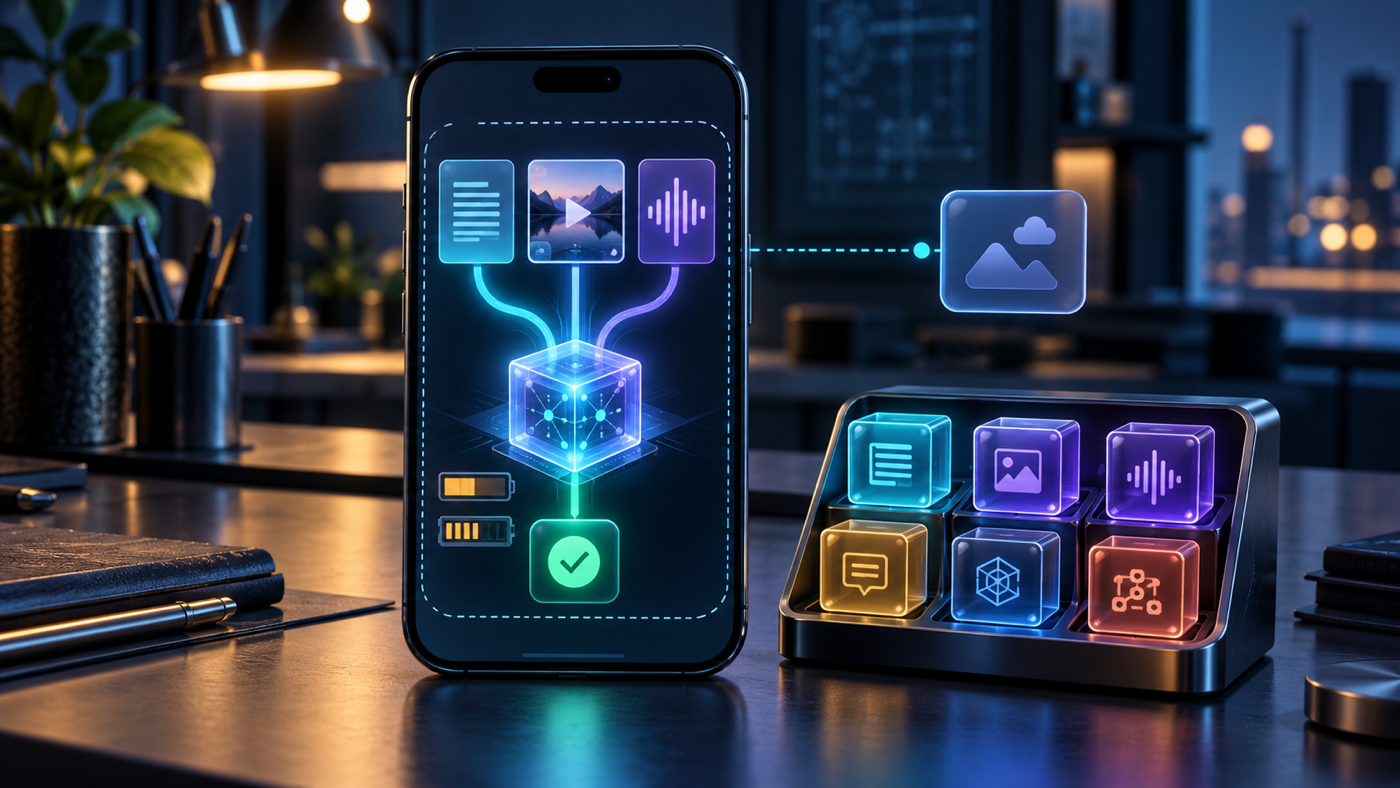
Liquid AI released LFM3 on October 27, a new open-weight family built for specialized applications on local hardware. Six compact models cover text, vision, audio, combined multimodal input, and structured decisions. Liquid also provides single-GPU fine-tuning examples for adapting them to specific tasks.
Three details that shape deployment
- Local agents: LFM3-1.7B supports tool calling and a 256K-token context window, with training aimed at harnesses including OpenClaw, Hermes Agent, and Pi. Liquid explicitly advises against using it for agentic coding or complex multi-step reasoning.
- Sight and sound together: LFM3-Omni-2B accepts text, images, video, and audio, and responds with text or speech. Its context window is 32K—not the text model’s 256K.
- Conditional commercial use: these are open weights under Liquid’s custom license. Commercial licensing includes a $10 million annual-revenue threshold; larger businesses need a separate agreement. This is not an unrestricted Apache 2.0 release.
Why it matters for builders
For builders, the opportunity is a small model tailored to one useful job: extracting structured information, interpreting an image, or turning a spoken instruction into an app action. Model choice should follow that job rather than assuming every member of the family has the same inputs, outputs or limits.
For SunMarc App Labs, a sensible first experiment would be one bounded on-device feature, tested on representative inputs and target phones. Local inference could reduce cloud dependence, but speed, battery use, memory requirements, and accuracy still need measurement. Connected tools may also continue sending data off-device.
That makes the first decision an evaluation question: does the feature work reliably within the intended phone’s resource budget? This is a proposed experiment, not an announced SunMarc feature or a claim that we have tested LFM3.
Our coverage of NVIDIA Bolt E4B for local agents explores a related small-model opportunity, with different modality and deployment constraints.