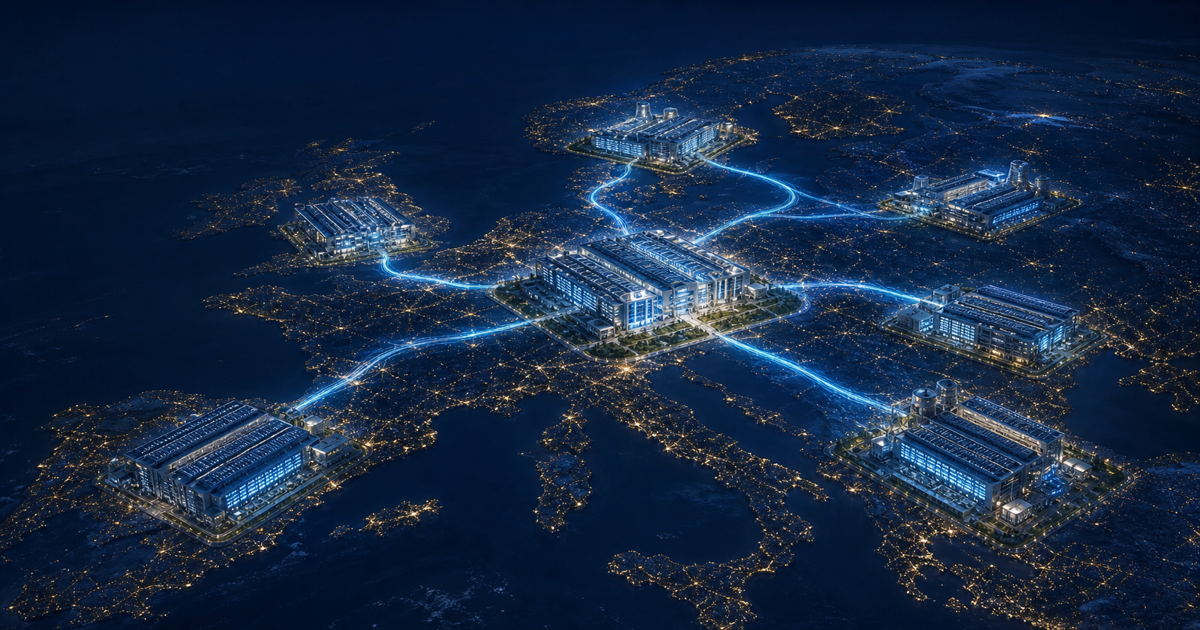
Europe is moving from AI regulation to AI infrastructure. The European Union has opened bidding for up to seven AI gigafactories: large computing campuses designed to train, fine-tune, and operate the next generation of advanced models.
Each facility is planned around at least 100,000 cutting-edge AI processors. Together, the seven sites would more than double the computing power available through the EU's existing network of 19 AI factories.
A €30 billion public-private buildout
The funding structure is designed to mobilize more than €30 billion. The EU and host countries would provide roughly €10 billion in public money, with private partners expected to invest about €20 billion more.
The public contribution is not all locked in. Reporting by Le Monde says €5 billion would come from the EU budget, but €4 billion of that depends on the bloc's next long-term budget, which is still under negotiation. Host countries would match the EU contribution, while successful commercial partners would invest twice the public support they receive.
Bidders have until November 12 to submit proposals. If selection, financing, construction, and grid access stay on schedule, the first sites are expected to become operational around mid-2028.
Why compute has become strategic infrastructure
Frontier AI is no longer only a contest between model architectures and training data. It depends on access to advanced processors, dependable energy, cooling, high-speed networks, engineering talent, and billions of euros in patient capital.
That makes compute capacity comparable to industrial infrastructure. Without it, European researchers and companies may have strong ideas but still depend on foreign cloud and AI providers to train and serve their most capable systems.
The European Commission frames the gigafactories as a way to give startups, researchers, industry, public bodies, and small businesses access to large-scale computing and high-quality data under European rules.
Sovereignty still depends on imported chips
The program is meant to strengthen European technological autonomy, but its first phase will still rely heavily on processors from American suppliers such as Nvidia and AMD. Europe currently lacks domestic alternatives at the performance and volume required for facilities of this scale.
The Commission's longer-term bet is that predictable demand from the new campuses can help stimulate European chip design and eventually manufacturing. In the near term, however, the sovereignty gain comes mainly from locating and governing the infrastructure in Europe—not from owning every layer of its supply chain.
Energy and water are part of the AI race
Seven giant compute campuses also create an energy and sustainability test. AI data centers require enormous electrical capacity, grid connections, cooling systems, backup power, and water or air resources.
The Commission says only projects with the strongest sustainability performance will be selected. The practical questions will be harder: whether each location can add new low-carbon generation, avoid raising local power costs, secure grid capacity on time, and cool its systems without placing unacceptable pressure on surrounding communities.
The bigger signal
Europe's AI strategy is broadening from rules and research programs into full-stack industrial policy. The proposed Cloud and AI Development Act aims to expand energy-efficient data-center capacity, simplify deployment, and reduce strategic dependencies; the gigafactory call gives that direction a physical form.
The global AI race is becoming an infrastructure race. Regions that want competitive AI ecosystems will need models and software, but also chips, electricity, capital, construction capacity, and operational expertise at a scale once associated with national energy and transport projects.
Relevant links
- European Commission: AI Gigafactories
- European Commission: Cloud and AI Development Act proposal
- Associated Press: EU funding plan for seven AI gigafactories
- Le Monde: Europe commits funding to seven AI megafactories
- SunMarc archive: AI sovereignty and infrastructure at WAIC 2026
- SunMarc archive: AI infrastructure as industrial policy