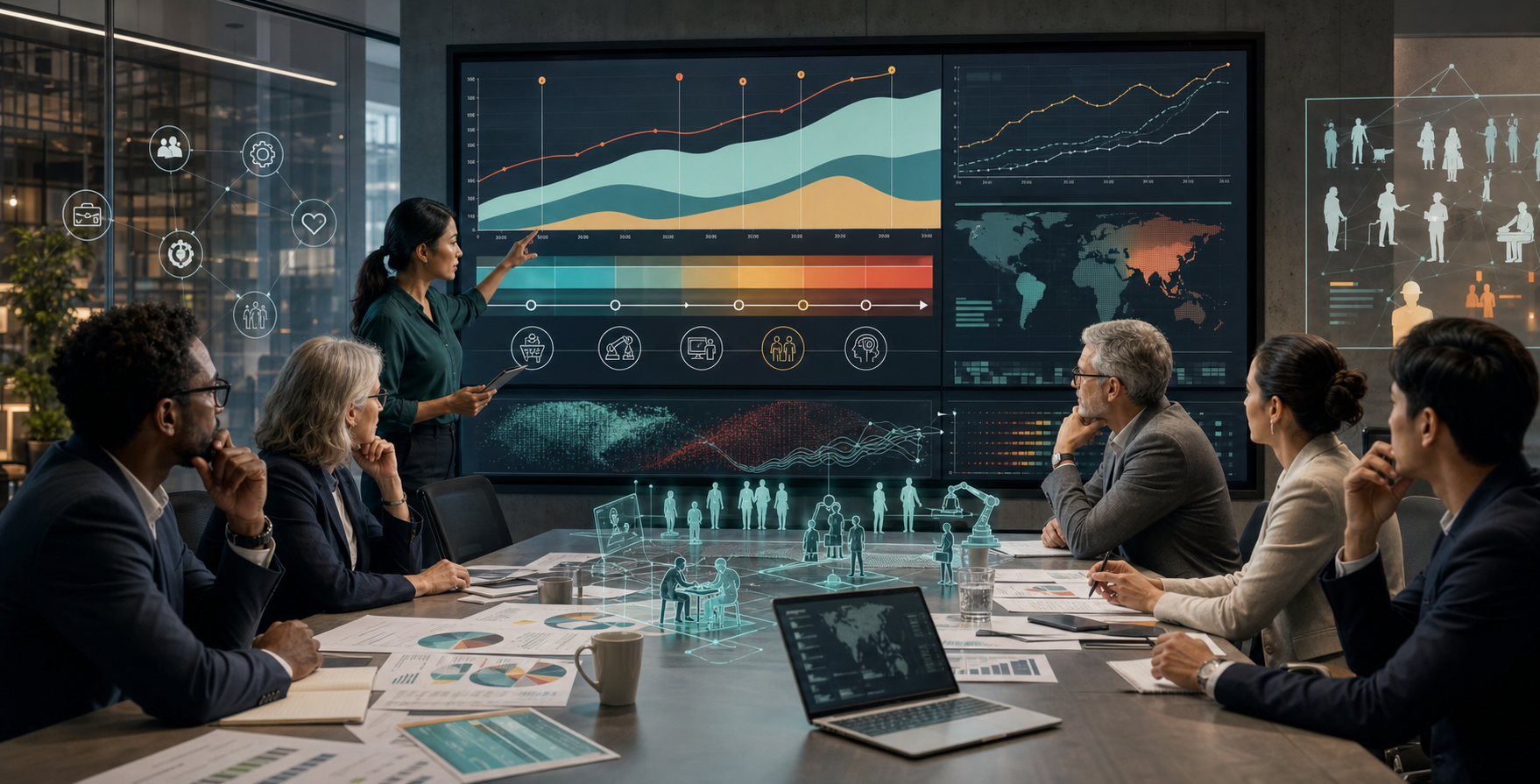
Hundreds of economists, AI researchers, and technology leaders, including 16 Nobel laureates, have signed "We Must Act Now," a warning about AI's economic impact. Their message is striking: AI could produce a transformation larger than the Industrial Revolution, but over a much shorter period.
That creates two realities at once. AI could raise productivity, improve services, and lift living standards. It could also displace work at a scale that institutions, labor markets, schools, and businesses are not ready to absorb.
The important shift is who is saying it. This is not only a safety-lab warning or a platform-company forecast. It is a broad economic signal from people who study productivity, markets, incentives, and the way technology reshapes jobs.
The debate is moving from capability to adaptation
The AI conversation has spent years asking whether models will become more capable. The economist letter moves the center of gravity toward a harder question: how quickly can society adapt if they do?
Stanford's Digital Economy Lab framed the statement as a call to prepare for AI's economic transformation. The signatories argue that economists, policymakers, and technology leaders need to understand the economics of transformative AI and build incentives, guardrails, and institutions that steer it toward broad benefit.
That word - steer - matters. The warning is not that AI progress must stop. It is that the direction of AI deployment will decide whether the benefits spread through useful tools, better services, and higher-quality work, or whether the gains concentrate while workers absorb the disruption.
This is where the statement becomes relevant for builders. A model can be technically impressive and economically harmful if it is deployed only to replace people without improving the surrounding system. The durable product opportunity is to build AI that helps people complete work, learn faster, make better decisions, and serve users with less friction.
Job disruption is a product design problem too
Large-scale labor shifts often sound like government policy issues, and they are. But they also show up inside product decisions. Every AI workflow has a design choice hidden inside it: does this system complement the user, supervise the user, deskill the user, or remove the user?
That choice changes the long-term value of the product. Tools that complement people can expand demand, raise output quality, and create new categories of work. Tools built only around replacement may generate short-term savings but increase resistance, oversight costs, trust problems, and regulatory attention.
For business users, the winning AI product will not simply say "we automated this role." It will say: here is the task we made faster, here is the quality bar, here is how the human stays in control, here is what gets measured, and here is where the system asks for help.
That is also why the debate connects with the useful-intelligence-per-dollar lens we covered recently. The valuable unit is not model activity. It is accepted work, completed with reliability, clear cost, and a human outcome that users recognize as useful.
Complementing humans should be concrete
"Complement humans" can become a soft phrase unless product teams turn it into requirements. A useful AI feature should make a person faster without hiding uncertainty. It should expose sources, offer reversibility, reduce repetitive steps, and leave judgment where judgment matters.
In consumer products, that could mean AI that helps someone organize documents, rewrite a listing, turn rough notes into a post, or compare trip costs without taking over the whole workflow. In business products, it could mean AI that drafts, classifies, checks, routes, and summarizes while preserving audit trails and escalation paths.
The strongest products will make the user more capable. They will not merely imitate the user. That distinction is central to the economist warning because labor displacement is not just about whether an AI can do a task. It is about how companies choose to package, price, govern, and measure that capability.
Institutions are behind the deployment curve
The speed concern is credible because institutions move slowly. Schools, credentialing systems, worker retraining programs, labor regulation, procurement rules, tax systems, and corporate operating models were not built for a technology that can spread across knowledge work in months.
The Industrial Revolution comparison is powerful because earlier technological shifts gave societies longer adjustment periods. AI may compress similar questions into a much tighter window: which tasks remain human, which tasks become machine-assisted, which jobs get redesigned, and who captures the gains?
That uncertainty is why this debate will not be resolved by one letter. Axios noted the statement has also triggered pushback from people who worry that premature policy action could block major benefits. That criticism is part of the story. The real consensus is narrower but important: AI is becoming one of the central economic questions of the decade.
Why it matters
The debate is shifting from whether AI will affect work to how quickly institutions and businesses can adapt. For product builders, the durable opportunity is increasingly clear: create AI tools that complement people, remove repetitive work, and deliver measurable value, not automation for its own sake.
That means the next useful AI products will be judged by outcomes: a cleaner document action, a better customer reply, a faster research workflow, a safer code change, a clearer finance decision, or a more accessible creative process. Vague intelligence will matter less than specific completed jobs.
It also means the product story must include trust. If AI systems reshape work, users need to know what is being automated, where their data goes, when a human is involved, what can be undone, and how errors are caught. Trust is not decoration. It is adoption infrastructure.
The SunMarc angle
For SunMarc App Labs, this is a useful product filter. AI should be added where it helps a real user job, not where it creates a buzzword. QR Remix can stay focused on clearer QR workflows. PDF Merger & Splitter can protect local, practical document handling. WattSave can explain energy-cost decisions. Future AI-assisted tools should begin with the user's task, not the model's spectacle.
The same applies to SunMarc's web growth. Content should help people understand technology shifts in practical terms. Internal links should connect big AI debates back to actual product decisions: utility, reliability, privacy, cost, and user control.
The economist warning is not a reason to freeze. It is a reason to build more carefully. The opportunity is to make smaller, sharper tools that help people do useful work while bigger institutions figure out the broader transition.
The product lesson
AI's economic impact will not be decided only by frontier labs, lawmakers, or academic statements. It will be decided in millions of implementation choices: what gets automated, what gets assisted, what stays local, what stays human, what gets measured, and what users are told.
The companies that treat AI as a labor-market design problem will build better products than the companies that treat it as a feature label. They will know the task, define the outcome, measure the cost, protect the user, and keep the system accountable.
That is the constructive reading of "We Must Act Now." The warning is serious, but it points toward a better builder discipline: make AI useful, measurable, reversible, and human-centered before the economic shock arrives.
Relevant links
- We Must Act Now - original statement
- Stanford Digital Economy Lab announcement
- Associated Press: economists warn on AI's economic impact
- Axios: top economists issue warning on AI's implications
- SunMarc archive: AI's New Unit of Value Is the Successful Task
- SunMarc archive: The AI Jobs Apocalypse Narrative Is Getting a Reality Check