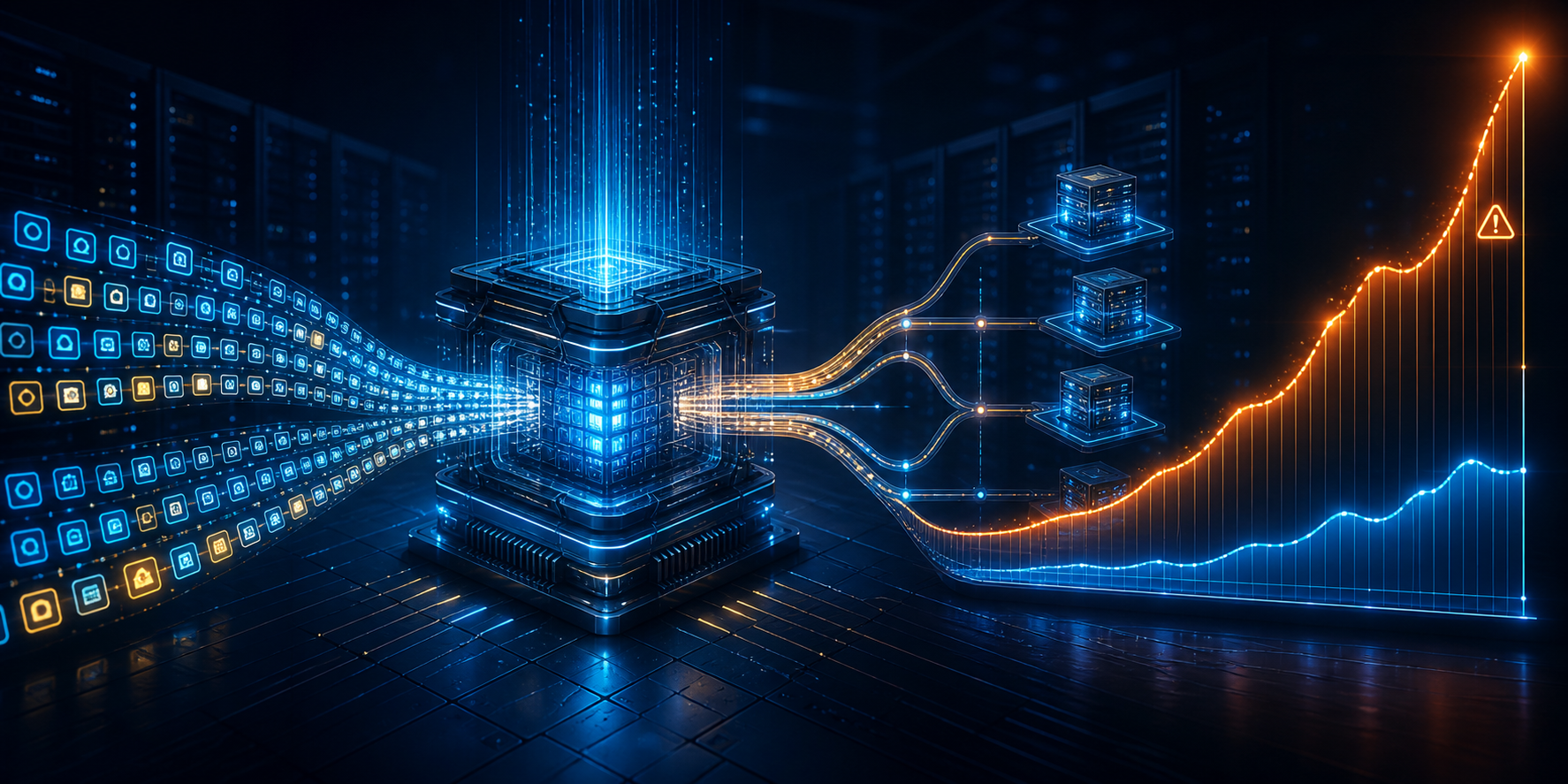
DeepSeek is preparing to replace one flat price with peak and off-peak billing for its V4 API models. According to notices reported ahead of the change, the new rates take effect at 16:00 UTC on August 16, with off-peak usage charged at half the peak rate.
The clearest example is V4 Flash. Its current listed rates are $0.14 per million uncached input tokens and $0.28 per million output tokens. The reported schedule moves those figures to $0.22 and $0.66 off-peak, or $0.44 and $1.32 at peak time. Even the cheaper window would therefore cost more than today for those two categories.
Cheap intelligence still runs on scarce machines
DeepSeek helped intensify the AI price war by putting capable models behind unusually low API rates. Axios recently described that competition as a race toward commoditized intelligence, while Fortune highlighted V4’s rock-bottom launch pricing against leading US models.
The new structure adds an important qualification. Efficient model architecture can reduce the compute required for each token, but it does not make serving capacity unlimited. GPUs, memory bandwidth, power, networking and data-center throughput still have to absorb real traffic. Peak pricing is one way to move flexible jobs away from congested hours while charging latency-sensitive customers more when demand is highest.
That does not prove why DeepSeek changed its rates; the company can adjust pricing for many commercial or operational reasons. But time-of-day billing makes capacity pressure visible to developers in a way a single token price does not.
The API price is now part of application state
A product that hard-codes one model and assumes one permanent rate inherits every pricing change. The immediate engineering response is not necessarily to leave DeepSeek. It is to stop treating the model endpoint as an immovable dependency.
Teams with delay-tolerant work can queue evaluations, document processing, embeddings and batch generation for cheaper windows. Repeated system prompts and stable context should be designed for cache reuse. Every production request should record the model, provider, cached and uncached tokens, output tokens, latency, retries and estimated cost. Without that telemetry, a pricing change can quietly turn a successful feature into an expensive one.
Routing matters too. A small compatibility layer can send requests to different models or inference providers based on task quality, latency, availability and live cost. That is especially relevant for open-weight models, which may be served by several vendors or deployed on controlled infrastructure. The cheapest route still needs evaluation: a lower token price loses its advantage if it produces longer answers, more retries or worse task completion.
A practical pricing lesson
The broader AI price war is not over. Model capability can keep getting cheaper even while individual providers raise specific rates. What changed is the assumption that today’s bargain price will remain the foundation of tomorrow’s unit economics.
Builders should budget with ranges, test fallback models before they are urgently needed, and put price changes through the same operational discipline as latency regressions or rate-limit changes. Cheap AI is valuable. Portable AI is durable.