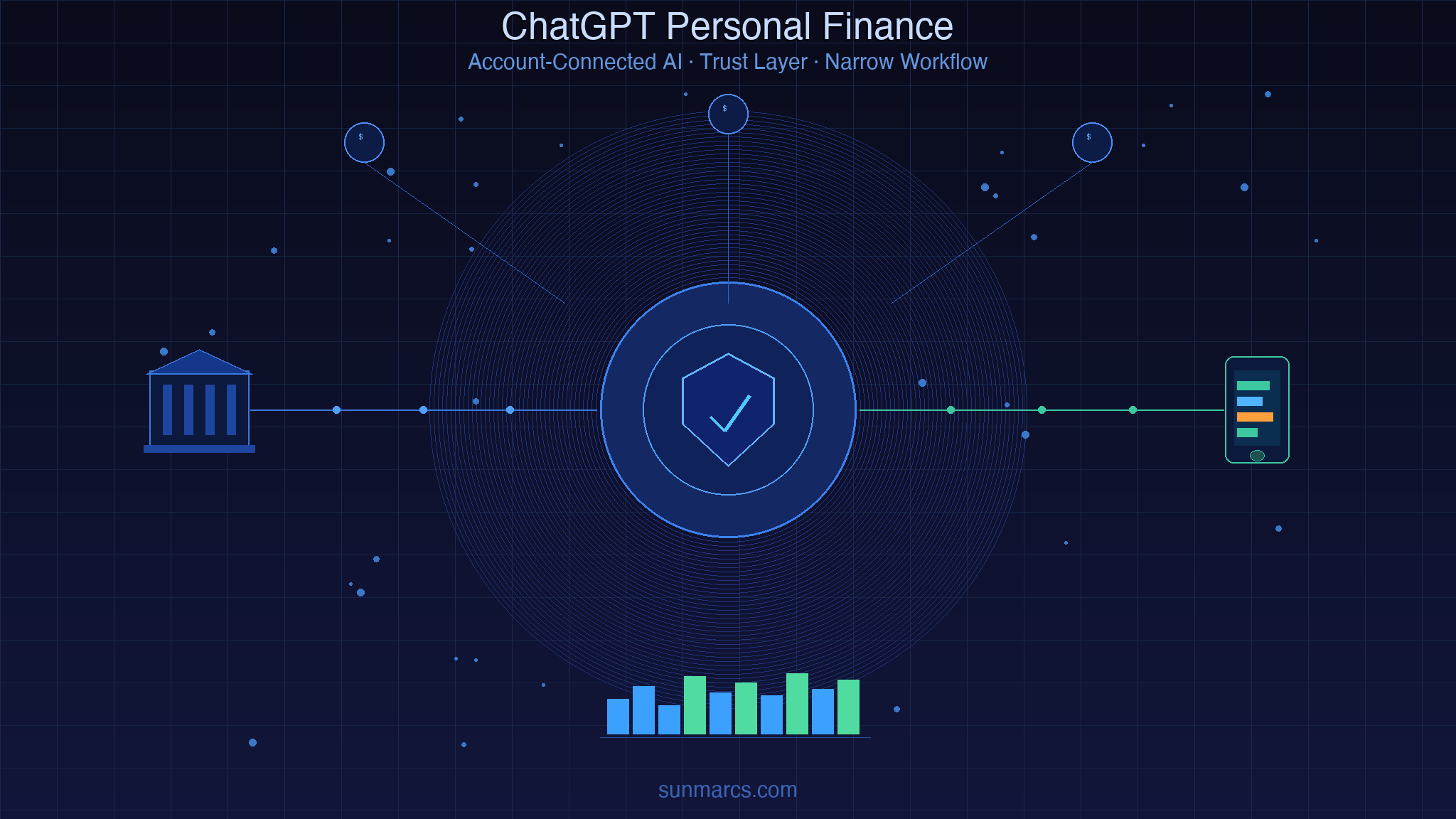
OpenAI is previewing a personal finance experience inside ChatGPT, currently available to U.S. Pro subscribers. Users can connect accounts from more than 12,000 financial institutions through Plaid, view a money dashboard showing balances, transactions, investments, and liabilities, and ask questions grounded in their actual financial data. The feature also lets users save financial goals and memories, and points toward partner actions — including a connection to Intuit.
That is a significant step. ChatGPT has spent its first few years as a general-purpose assistant. This moves it into a narrower, more sensitive category: a tool that holds read access to your real bank accounts, knows your spending history, and is being asked to act on that data. The product story here is not the AI capability itself — it is the trust design.
What the feature actually does
The connection flow runs through Plaid, a financial data aggregator that already underlies most consumer fintech products. Users grant read-only access to their accounts, and ChatGPT receives a live view of balances, transaction history, investments, and liabilities. A dashboard surfaces the headline numbers. The conversational layer lets users ask questions like "how much did I spend on food last month" or "am I on track for my savings goal" — and get answers grounded in real account data rather than general advice.
OpenAI has also added the ability to save financial memories and goals, so the assistant can refer back to stated objectives across conversations. The Intuit integration points toward a workflow layer: tax preparation, bookkeeping, or financial planning actions that go beyond just reading data.
As of this writing, the feature is in preview and limited to Pro users in the United States. It has not launched broadly.
The trust layer is the product
Connecting an AI assistant to bank accounts is a different kind of product decision than adding a web search tool or a code interpreter. Financial data is among the most sensitive a user can share. It reveals income, spending patterns, debt levels, relationship structures, health spending, and behavioral fingerprints that extend far beyond what most users consciously share anywhere online.
OpenAI's announcement language is careful on this front. The feature is described as read-only. Permissions are explicit and user-initiated. Data handling disclosures are part of the setup flow. These are not incidental details — they are the core product design decisions that determine whether this feature earns user trust or erodes it.
The questions that matter are not really about whether the AI can read a bank statement. They are: Where does the data go? Is it used to train models? What happens in a breach? Can users revoke access cleanly? What does the model do when it receives incorrect or incomplete account data? How are errors in financial advice surfaced to the user? The credibility of this feature lives or dies on the answers to those questions, not on the quality of the summaries it produces.
Why the scope matters
The preview scope — U.S. Pro users, read-only access, Plaid as the connection layer — is notable precisely because it is narrow. Narrow scope is how sensitive AI features earn trust incrementally. A tool that reads balances and answers questions is categorically different from a tool that initiates transfers, pays bills, or files taxes. OpenAI appears to be drawing that line clearly for now.
But the directional intent is clear. The Intuit integration, the financial memories, and the goals feature are not dashboard utilities. They are workflow primitives. The read-only dashboard is the first phase; the second phase is action. How OpenAI handles the transition between reading financial data and acting on it will be one of the more consequential product trust decisions of the next few years.
What this means for the broader AI landscape
ChatGPT's move into personal finance is part of a pattern visible across the industry: AI assistants are moving from general-purpose advice into account-connected, permission-gated workflows. The earlier phases — search, writing, coding, image generation — involved no privileged access to user systems. These new phases do. Every major AI lab is working through the same design problem: how do you let an AI take meaningful action in a user's financial, health, or professional life without creating risk that outweighs the utility?
The companies that get this right will not be the ones with the most capable models. They will be the ones that make the permission model legible, the scope constraints visible, and the data handling verifiable. Users are willing to grant access to sensitive systems — they do it every day with financial apps, health trackers, and calendar tools. The question is whether they trust the specific product enough to do it again with an AI assistant.
What readers should watch
The personal finance preview is a useful reminder of what makes account-connected AI products defensible. It is not the AI layer — that is increasingly commoditized. It is the narrow scope, the explicit permissions, the transparent data handling, and the human override points that determine whether a product earns a place in a sensitive workflow.
The same logic applies to any AI-assisted tool that touches real user data: health records, communications, documents, financial accounts. Useful automation without visible trust infrastructure is not a product — it is a liability. The winning pattern is not "AI that knows everything about you." It is "AI that knows what you've explicitly shared, acts within the scope you've defined, and shows you what it's doing."
ChatGPT's personal finance feature will be judged not by how impressive the money dashboard looks, but by whether users feel in control of what they've shared — and confident they can take it back.