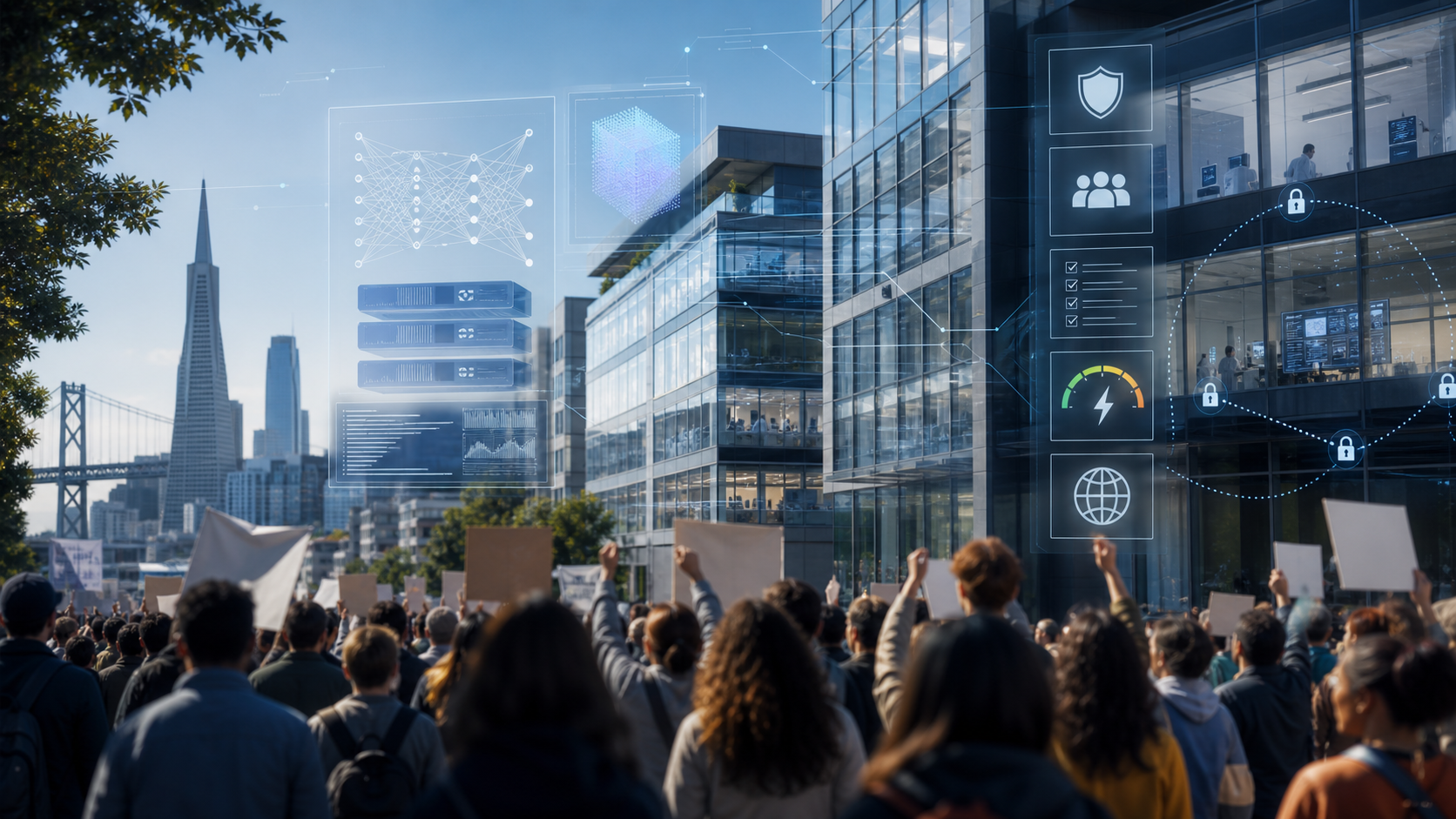
On July 11, 2026, protesters marched through San Francisco to OpenAI, Anthropic, and Google DeepMind, calling for major AI labs to pause frontier model development if their competitors agree to do the same.
The crowd was not just objecting to one product launch. The message was broader: the AI race is now being judged on jobs, rents, energy use, public trust, safety commitments, and whether labs can credibly govern systems that are becoming more agentic and more embedded in work.
That makes this protest worth watching. AI is moving from chatbot novelty into infrastructure: coding agents, work platforms, research tools, operating-system integrations, customer-support workflows, and always-on assistants. As the technology becomes more capable, the public debate is shifting from "what can it do?" to "who controls the pace, the rules, and the costs?"
The doorstep matters
AI criticism has been online for years, but the location of this protest is the important signal. Marching from one lab to another turns an abstract technology debate into a local accountability moment. The companies building frontier systems are not invisible cloud entities. They have headquarters, executives, employees, neighborhoods, energy needs, hiring effects, and policy influence.
That is why the protest sits at the intersection of several concerns. Some people are worried about existential risk. Others are focused on jobs, housing, data centers, classroom tools, copyright, model behavior, energy use, and the pace of deployment. Those concerns do not all come from the same political place, but they are starting to point at the same target: concentrated AI power moving faster than institutions can explain or govern.
For AI labs, this creates a harder communications problem. A better benchmark score does not answer a resident's concern about power use. A new coding model does not answer a worker's concern about job redesign. A polished safety system card does not fully answer a user's concern about what an agent can do inside their files, apps, or business accounts.
The pause demand is really a coordination demand
Stop The AI Race frames its central demand as conditional: every major AI lab CEO should publicly commit to pausing frontier model development if every other major lab credibly does the same. That structure matters because it treats the AI race as a coordination failure, not simply a villain story.
Each lab can argue that slowing down alone would hand advantage to competitors. Activists are trying to force the opposite question: if the main barrier is mutual distrust, what public commitment would prove that the labs are willing to coordinate around safety?
Whether or not that demand becomes practical policy, it captures a real market tension. Labs are competing for talent, compute, enterprise customers, government relationships, developer mindshare, and consumer attention. That race rewards speed. Public trust rewards restraint, accountability, and evidence that deployment boundaries are more than marketing language.
Backlash is becoming a product requirement
For builders, the lesson is not that AI products should stop. It is that useful AI products will need more than model access and clever interfaces. They will need clear permissions, visible boundaries, reliable memory, privacy controls, audit trails, source behavior, recovery paths, and a story users can trust.
This is especially true for agents. A chatbot that answers a question can be wrong and still feel contained. An agent that reads files, opens tools, writes code, sends messages, schedules tasks, or changes records creates a different trust problem. The user needs to know what the system can access, what it plans to do, when it needs approval, what it has already done, and how to reverse or inspect the result.
That is why AI backlash should be treated as design input. When people worry about jobs, data, energy, or autonomy, product teams should translate those worries into controls: local processing where possible, granular consent, visible logs, limited scopes, cost caps, human review points, and plain-language explanations of what happens next.
Enterprise pressure and public pressure are converging
The San Francisco protest arrived just after another signal: enterprise AI buyers are starting to push back on frontier lab economics, workflow ownership, and unclear return on investment. These are different audiences, but they are asking related questions.
Enterprises want to know who owns the workflow, where data goes, why token bills are rising, and whether model access is becoming a dependency trap. Civil-society critics want to know who controls deployment speed, who pays for external costs, and whether safety commitments can hold under competitive pressure.
Both groups are reacting to the same shift. AI is becoming infrastructure. Once a technology becomes infrastructure, users and institutions stop treating it as a novelty and start treating it as power: economic power, operational power, political power, and platform power.
The SunMarc takeaway
For SunMarc App Labs, the practical takeaway is direct. AI-enabled products should make the workflow visible and owned by the user. The strongest products will not simply bolt a chat box onto a task. They will show the inputs, the transformation, the permission boundary, the output, and the next action.
That applies across the SunMarc portfolio. QR Remix should keep transformations inspectable before a new code is generated. PDF utilities should preserve local processing, previews, and reversible steps. Navigation and utility tools should make data use obvious. Sound Scout-style products should communicate when processing is local and when the user is in control. Future AI-enabled web properties should expose sources, actions, permissions, and costs in plain language.
Products like OpenClaw-style agents benefit from the same shift. Users want AI that can act, but only inside trusted, understandable limits. The opportunity is not just to make agents more powerful. It is to make them legible enough that people can safely give them responsibility.
Where this points
The next wave of AI adoption may depend as much on governance and product design as raw capability. Labs will keep racing. Regulators will keep reacting. Activists will keep pushing. Buyers will keep asking for proof. In the middle, product builders have a chance to turn public anxiety into better interfaces and clearer operating contracts.
The AI race backlash has reached the lab doorstep because the technology has reached everyone else's doorstep. That is the new context for AI product work. Trust is no longer a footer note. It is part of the product.
Relevant links
- San Francisco Chronicle: S.F. protesters march on OpenAI, Anthropic and Google DeepMind
- Mission Local: Photos from the protest at OpenAI, Anthropic, and Google DeepMind
- Reuters Connect: Hundreds rally in San Francisco against AI race
- Stop The AI Race: campaign demand and event framing
- The San Francisco Standard: Inside the anti-AI protest
- SunMarc archive: Enterprise AI Buyers Are Starting to Push Back on the Labs
- SunMarc archive: GPT-5.6 Turns OpenAI's Model Launch Into a Work Platform